
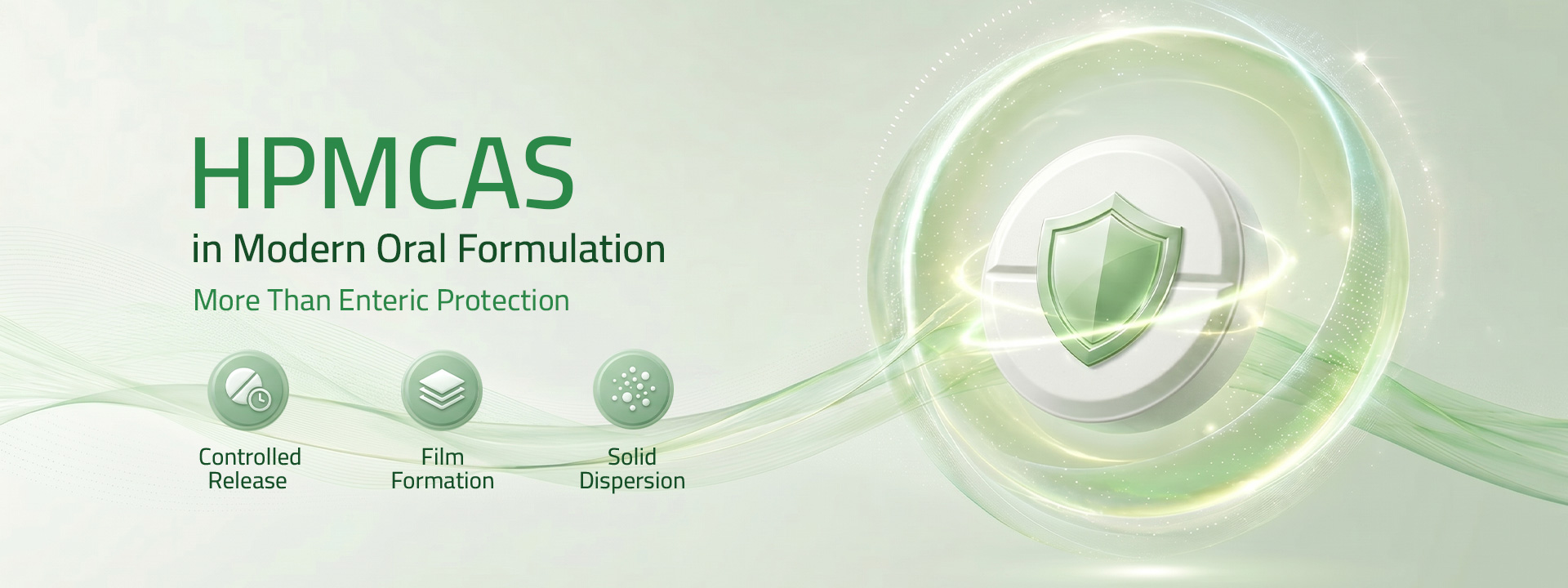
Most formulators encounter HPMCAS for the first time when they need an enteric coating solution. Many never go back to explore what else it can do. That is a missed opportunity.
Oral dosage forms carry a complex set of requirements. The formulation may need to protect the API from gastric conditions, delay release until the intestinal environment, support film formation in oral solid dosage forms, or address solubility challenges for a poorly soluble API. A single excipient rarely covers all of these needs, but HPMCAS brings together several important functions within one polymer.
For formulation teams working on oral solid dosage forms, Hypromellose Acetate Succinate, commonly known as HPMCAS, connects release behavior, polymer functionality, and formulation performance within a single material. Understanding that range of functionality is what helps formulation teams make better use of it.
The Reason Formulators Keep Coming Back to HPMCAS
Enteric protection remains one of the most important reasons to choose HPMCAS. Many APIs require protection from the acidic environment of the stomach, and in other cases the formulation target is to delay release until the dosage form reaches the intestinal environment.
HPMCAS supports this type of formulation approach because of its pH-dependent behavior. It is insoluble in gastric fluid and becomes relevant when the formulation reaches the intestinal environment, where it can swell and dissolve. That characteristic makes it useful when release timing is a key part of the formulation design.
However, the value of HPMCAS extends beyond enteric coating alone. It is also used as a film-forming agent, a controlled-release agent, a sustained-release agent, and a solubility-enhancing agent. That combination makes it a versatile excipient for formulation teams working on oral solid dosage forms with more than one technical requirement.
HPMCAS is not just an enteric polymer. It is a formulation decision that touches release behavior, film formation, solubility strategy, and the documentation needed for pharmaceutical evaluation.
What the Right Question Actually Looks Like
Enteric polymers are often discussed only in terms of stomach protection. That is part of the story, but not the full story.
In real formulation work, the question is not only whether the polymer can protect the API from gastric fluid. The more complete question is whether the polymer supports the required release behavior and formulation objective.
HPMCAS helps formulators approach this question more strategically. It can be considered when the formulation requires pH-dependent release, film formation, delayed release, controlled-release behavior, or solubility-focused development. This makes it especially relevant when the dosage form requires more than a basic protective coating.
Understanding HPMCAS LG, MG, and HG
HPMCAS is available in different grades, including LG, MG, and HG. These grades differ in their substitution profile, covering methoxy, hydroxypropoxy, acetyl, and succinoyl content. Those differences influence how the polymer behaves in formulation and make each grade suitable for different development scenarios.
In general formulation practice, the selection between LG, MG, and HG typically begins with the target release environment and the API’s chemical characteristics. Starting that evaluation early, and discussing it with your excipient partner, helps narrow the options before extensive development work begins.
The final grade choice should reflect the API, dosage form, formulation design, target release behavior, processing method, and documentation requirements. At ALKAN Chemical Europe, available HPMCAS grades include LG, MG, and HG, supported with the relevant documentation for pharmaceutical evaluation.
The question is not which polymer is the most well-known. The question is which grade matches the formulation challenge.
HPMCAS and Solubility-Focused Formulation
Solubility remains one of the most common challenges in oral drug development. When an API has limited solubility, the formulation may require additional support from suitable excipients and formulation strategies.
HPMCAS can be considered in this area because it is used as a solubility-enhancing agent and can be part of solid dispersion development. In solid dispersion systems, the polymer can support the dispersion of the API within a suitable carrier system. This can be useful when the development goal is to address dissolution-related formulation objectives.
The suitability of HPMCAS for a specific solubility-focused project should always be evaluated according to the API, formulation target, selected grade, and process route. No two development projects are identical, and the excipient selection should reflect that.
HPMCAS in Solid Dispersion Development
HPMCAS is relevant in solid dispersion development because it combines pH-dependent behavior with polymer functionality. For poorly soluble APIs, solid dispersion can be one route to support formulation performance, and HPMCAS may be evaluated as part of that approach depending on the API characteristics and the intended dosage form.
Preparation of solid dispersions may involve different formulation techniques, including mechanical grinding, solvent evaporation, or melt extrusion. The most suitable route depends on the API, grade, process conditions, and development objective.
This is why early evaluation matters. HPMCAS should not be selected only because of its name. It should be selected because its properties match the formulation challenge.
Five Formulation Scenarios Where HPMCAS Is Worth Evaluating
One of the most practical ways to approach HPMCAS during development is to start with the formulation problem rather than the excipient name.
When the API requires protection from gastric conditions, HPMCAS can support enteric protection. When the target is delayed release after gastric transit, its pH-dependent behavior becomes the relevant property. When the project involves film formation, HPMCAS can be evaluated for coating applications. When the formulation requires controlled or sustained release, HPMCAS can be considered as part of the formulation design. And when the API has solubility challenges, HPMCAS can be evaluated in solubility-focused strategies, including solid dispersion development.
One polymer. Multiple formulation conversations. That is the practical value of treating HPMCAS as a formulation tool rather than a category label.
How HPMCAS Compares With Classical Enteric Polymers
Formulators already working with HPMCP or CAP sometimes ask whether HPMCAS is simply a newer version of the same idea. It is not quite that straightforward.
Classical enteric polymers such as HPMCP and CAP remain important in pharmaceutical formulation and are commonly used for delayed release, gastric protection, and enteric coating applications. HPMCAS is also part of the enteric polymer family, but it has a broader functional profile. It covers enteric protection, pH-dependent release, film formation, controlled-release and sustained-release support, and solubility-focused formulation within a single material.
For formulation teams working on oral solid dosage forms with multiple technical requirements, that broader functionality is what makes HPMCAS worth evaluating alongside more familiar options.
Why Grade Selection Matters More Than the Excipient Name
Even when the same excipient name is used, different grades can behave differently in formulation. For HPMCAS, LG, MG, and HG provide distinct options for evaluation. The selected grade should be aligned with the API, dosage form, target release behavior, processing method, and documentation expectations.
This matters because excipient selection is not only a technical decision. It also affects quality review, regulatory evaluation, and long-term sourcing. Choosing the right grade early can help formulation, QA, and regulatory teams evaluate the material more efficiently.
The Part of Excipient Selection That Gets Overlooked
In pharmaceutical sourcing, excipient selection is never based on functionality alone. The selected material must also fit the customer’s quality and regulatory pathway. This becomes especially important when the excipient is part of a long-term formulation project, validation work, or a registration file.
At ALKAN Chemical Europe, we support pharmaceutical customers with both sourcing and documentation for HPMCAS grades. This may include product information, specifications, certificates of analysis, compliance documents, and other quality documents required for evaluation.
For formulation teams, this combination of material availability, technical discussion, and documentation support is not a secondary consideration. It is part of the excipient decision.
Final Thoughts
HPMCAS is more than a traditional enteric polymer. Its value comes from the way it connects gastric protection, pH-dependent release, film formation, controlled-release and sustained-release concepts, and solubility-focused formulation development within a single excipient.
For oral solid dosage forms, it can be considered whenever the formulation requires more than simple protection from gastric fluid. The key is to approach it as a formulation tool, matching the grade, API, dosage form, process route, and documentation requirements to the actual development objective.
When those elements are aligned, HPMCAS can offer real value in modern oral formulation development. The best place to start that evaluation is a structured conversation with a sourcing partner who can support both the technical and the documentation side of the decision.
Looking for HPMCAS for your formulation project?
ALKAN Chemical Europe can support pharmaceutical manufacturers with selected HPMCAS grades, including LG, MG, and HG, backed by competitive pricing, strong documentation, and technical-commercial support.
If you are evaluating HPMCAS for an ongoing or upcoming project, our team is available for a technical-commercial discussion. No commitment required at this stage.
FAQ: HPMCAS in Pharmaceutical Formulation
What is HPMCAS used for?
HPMCAS is used in oral solid dosage formulation for enteric protection, pH-dependent release, film formation, controlled-release concepts, sustained-release formulation approaches, and solubility-focused development.
Is HPMCAS only used for enteric coating?
No. HPMCAS is widely known as an enteric polymer, but it can also be used as a film-forming agent, controlled-release agent, sustained-release agent, and solubility-enhancing agent.
What are HPMCAS LG, MG, and HG?
LG, MG, and HG are HPMCAS grades with different substitution profiles. These grades can be evaluated depending on the API, dosage form, release target, and formulation requirements.
Can HPMCAS be used in solid dispersion development?
Yes. HPMCAS can be considered in solid dispersion development, especially where the formulation strategy requires a solubility-enhancing polymer. Suitability depends on the API, selected grade, and process route, and should be evaluated case by case.
Why does documentation matter when selecting HPMCAS?
Because pharmaceutical excipients must meet technical, quality, and regulatory expectations. Documentation helps formulation, QA, and regulatory teams evaluate whether the selected grade is suitable for the project.
How is HPMCAS different from HPMCP?
HPMCP is mainly known as a classical enteric coating polymer. HPMCAS also supports enteric protection, but it has a broader functional profile that includes film formation, controlled-release support, sustained-release support, and solubility-focused formulation.
Need support with HPMCAS grade selection?
Selecting the right HPMCAS grade requires alignment between API properties, release target, dosage form, process route, and documentation requirements.
ALKAN Chemical Europe supports customers across EMEA with excipient sourcing, documentation support, and structured grade discussions for pharmaceutical applications.
If you are evaluating HPMCAS for an ongoing or upcoming project, our team is available for a technical-commercial discussion. No commitment required at this stage.
Author
Dr. Peter Michael, Procurement & Sales Manager, ALKAN Chemical Europe
Pharmacist (B.Pharm). Supporting customers across EMEA with excipient and API sourcing backed by technical documentation.