
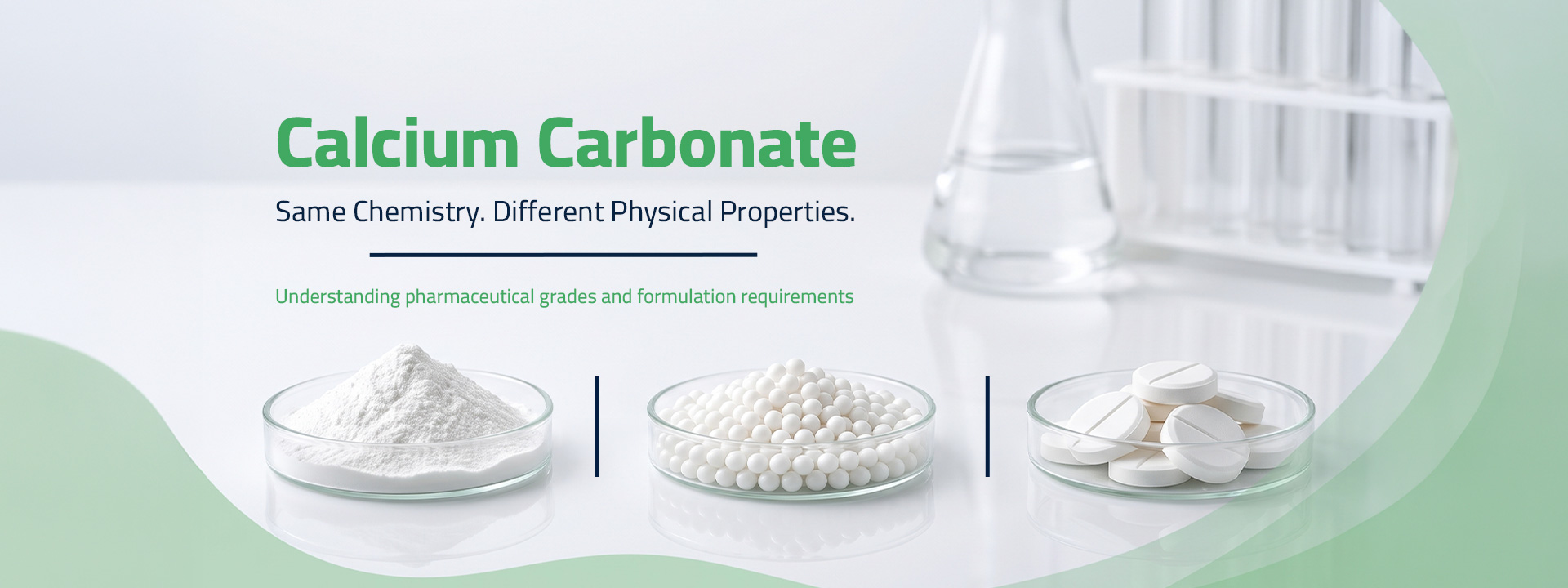
Calcium carbonate is often requested simply as “Calcium Carbonate USP/EP.” For a formulation or procurement team, however, the chemical name and requested standard are only the starting point. Different grades can behave differently during handling, blending and tablet production.
Calcium carbonate (CaCO₃) is used as a calcium source in supplements, as an active ingredient in antacid formulations and as an excipient in selected products. Depending on the grade, it may also be considered for nutraceutical, food and oral-care applications.
The practical question is not which calcium carbonate is universally best. It is which grade offers the right combination of physical characteristics, quality documentation and process suitability for the intended product.
Why Calcium Carbonate Grade Selection Matters
Two calcium carbonate powders can share the same chemical identity while differing in particle size distribution, crystal morphology, apparent density and powder-handling behaviour. Those differences may influence storage volume, feeding, blending and die filling. They can also affect whether a material is suitable for a particular tablet manufacturing process.
Grade selection is also a commercial decision. A lower price per kilogram may not be the most relevant comparison if the material needs additional process adjustments or does not satisfy the project’s quality requirements. Formulation and sourcing teams benefit from comparing the actual grade characteristics rather than the product name alone.
The appropriate starting point depends on the project. A supplement manufacturer may be concerned with calcium loading and tablet dimensions, while another formulator needs to assess powder flow or the suitability of a grade for a particular processing route. In each case, the technical specifications and available supporting data are more informative than a general grade label.
PCC, Light, Heavy and Direct Compression: What Do the Terms Mean?
These are useful market descriptions, but they are not four mutually exclusive chemical categories. PCC describes a manufacturing process; Light and Heavy generally refer to powder density characteristics; and Direct Compression refers to suitability for a particular manufacturing approach. A material can fit more than one description.
Precipitated Calcium Carbonate (PCC)
PCC is produced through controlled chemical precipitation. Depending on process conditions, precipitated grades can have different particle sizes and shapes, including cubic, prismatic, scalenohedral and rhombohedral forms. These properties can influence powder packing, surface characteristics and handling.
PCC should not automatically be equated with a light-density powder or with direct-compression performance. It is also different from Ground Calcium Carbonate (GCC), which is obtained by grinding naturally occurring calcium carbonate. Neither manufacturing route, by itself, establishes suitability for a regulated pharmaceutical application.
Light and Heavy Calcium Carbonate
In common commercial terminology, Light Calcium Carbonate is often associated with precipitated grades, whereas Heavy Calcium Carbonate is commonly associated with ground or higher-density material. However, these associations are not strict technical definitions. For a given mass, a lower-bulk-density powder occupies more volume, which can matter for storage, hopper capacity and feeding.
Importantly, both Light and Heavy designations can also occur within PCC ranges. The labels alone do not establish the production route, purity or flowability. Always refer to the grade-specific manufacturing information, bulk-density data and technical specifications when comparing materials.
Direct Compression (DC) Calcium Carbonate
Direct compression produces tablets by compressing an appropriate powder blend without a separate granulation step during tablet manufacture. It requires particular attention to powder feeding, die filling and the behaviour of the complete blend under compression.
Grades presented for direct compression may be specially processed, granulated or formulated to support tableting. Their composition can differ, so it is important to check whether the offered material contains calcium carbonate alone or includes other functional ingredients.
A DC designation is a useful starting point, not proof that a grade will work in every tablet. Powder flow, compactibility, tablet strength and disintegration must be evaluated under the intended formulation and processing conditions.
Four Material Properties Worth Checking
Particle Size and Morphology
Particle size distribution matters more than a single average particle size. A median size such as d50 can help compare products, but it does not describe the entire distribution. Crystal shape also influences how particles interact and pack. These measurements should be considered together with the target formulation and manufacturing route.
Particle-size values also need context: a technical brochure may provide a typical size, while a quality specification may use a different test method or acceptance range. Comparing grades responsibly requires understanding what has actually been measured and whether the reported value is a typical property or a controlled release parameter.
Bulk Density and Powder Handling
Bulk density indicates how much space a loose powder occupies; tapped density describes its packing after controlled tapping. They are not interchangeable measurements. Nor does a higher density automatically mean better flow. For manufacturing, available flow and density data should be interpreted alongside practical handling and blending requirements.
Flow and Tableting Behaviour
A powder may feed consistently into a tablet press without delivering the required tablet strength. Similarly, a grade that compacts well may not flow adequately in a particular process. When evaluating direct compression, both material handling and finished-tablet performance need to be assessed.
Sensory and Appearance Requirements
For chewable supplements and lozenges, particle characteristics may contribute to mouthfeel, appearance and processing behaviour. In toothpaste and other oral-care products, particle size and abrasivity may also be relevant, depending on the material’s intended function. These properties should be assessed for the individual grade and formulation.
Applications: From Tablets to Nutritional Products
Calcium carbonate contains approximately 40% elemental calcium by weight. This makes it a concentrated calcium source for supplements, where the formulation team may need to balance calcium loading with tablet dimensions, manufacturing performance and the desired product experience. Grade selection can be especially important when calcium carbonate represents a substantial proportion of the blend.
In antacid products, calcium carbonate functions as an active ingredient. Quality requirements and finished-product performance must be evaluated for the relevant dosage form. In other selected solid-dose formulations, calcium carbonate may be considered as an excipient, subject to compatibility and formulation testing.
Beyond conventional tablets, suitable grades may be evaluated for chewable tablets, nutritional supplements, lozenges, vitamin and mineral premixes, drink powders and selected fortified food products. Toothpaste and other oral-care formulations may require application-specific particle-size or abrasivity characteristics. Each application has its own quality, processing and sensory expectations. Pharmaceutical and food grades are not automatically interchangeable.
For food and beverage projects, the physical form of calcium carbonate can also matter to processing and product presentation. A powder intended for dry blending may need different properties from one being evaluated in a beverage or chewable formulation. Where relevant, customers should verify food-grade documentation, including E170 specifications for applicable EU food-additive uses or Food Chemicals Codex requirements, alongside other applicable contaminant controls.
Exploring Calcium Carbonate Grades for Your Project?
ALKAN offers PCC, Light, Heavy and Direct Compression calcium carbonate options for pharmaceutical and healthcare applications. Share your dosage form, desired material characteristics and quality requirements so our team can help identify a suitable grade for evaluation.
Purity, Documentation and Qualification
High purity is an important consideration, but “pharmaceutical grade” alone is not enough to qualify a raw material. The appropriate standards must be checked for the specific grade, intended use and destination market. Depending on the project, this can involve pharmacopoeial specifications, a Certificate of Analysis, technical and safety data sheets, and other relevant quality information.
For medicinal products, grade-specific elemental-impurity information, including data on elements such as lead, arsenic, cadmium and mercury where relevant, can support the finished-product manufacturer’s assessment under ICH Q3D when applicable. These data must be interpreted together with the exact grade specification and intended use; ICH Q3D is not a stand-alone certification for the raw material.
Typical particle-size or density values shown in a technical brochure should also be distinguished from formal batch-release limits. Where processing characteristics matter, technical-data review and sample testing can complement the quality-documentation assessment.
How ALKAN Supports Application-Specific Grade Selection
ALKAN supports pharmaceutical, nutraceutical and selected healthcare customers with grade-selection discussions, available technical documentation and coordination of material evaluation. The starting point can be a standard pharmaceutical-grade requirement or a more specific application challenge.
For customers developing customized formulations, ALKAN can review the intended process, preferred particle-size profile, density, powder handling and documentation needs. Where a standard grade description is insufficient, our team can discuss suitable material options and tailored requirements, subject to technical feasibility, grade-specific documentation and qualification. This is support for material selection and evaluation, not finished-product formulation or manufacturing.
Support may include discussions about samples, quality documentation and a commercial quotation. Specifications, availability and any application-specific requirements are confirmed for the proposed grade before an offer is finalized.
What to Include in a Calcium Carbonate Inquiry
A useful request should explain the intended application and dosage form, whether the process uses direct compression or granulation, the preferred grade type where known, any particle-size or density targets, required quality standards and documentation, expected quantity and delivery destination.
Even when the technical target is still being defined, an early discussion about these factors can help narrow the relevant options and make sample evaluation or pricing more meaningful.
Frequently Asked Questions
Is PCC the same as Light Calcium Carbonate?
Not exactly. In commercial use, Light Calcium Carbonate often refers to precipitated material, but PCC specifically identifies the manufacturing route. Some PCC ranges include both Light and Heavy grades, so the grade specification should determine the comparison.
Is Heavy Calcium Carbonate always ground calcium carbonate?
Not always. Heavy Calcium Carbonate is commonly associated with ground or higher-density material, but some precipitated calcium carbonate grades are also described as Heavy. Confirm the production route and density data for the specific grade.
Can calcium carbonate be used for direct-compression tablets?
Certain grades are intended for direct-compression evaluation. The suitability of any option depends on powder flow, compaction behaviour, composition and the complete formulation.
What should be checked for pharmaceutical qualification?
Start with the exact grade specification, relevant pharmacopoeial requirements, Certificate of Analysis and available technical documentation. Additional information, including elemental impurities, may be needed depending on the product and market.
Can ALKAN help select calcium carbonate for a customized formulation?
Yes. ALKAN can help customers evaluate calcium carbonate grades against their application-specific requirements, including particle characteristics, processing needs and documentation. Any tailored material option remains subject to technical review, qualification and availability.
Final Thoughts
Calcium carbonate grade selection is about more than the chemical name. Manufacturing route, particle characteristics, powder density, processing requirements and quality documentation all influence what makes a material suitable for a particular product.
Whether your project involves supplements, antacids, direct compression or specific formulation requirements, ALKAN can help you evaluate appropriate calcium carbonate grades and move the discussion toward sampling, qualification and supply.
Need Support with Calcium Carbonate Grade Selection?
Tell us your application, required specifications, estimated quantity and delivery destination. ALKAN can help you discuss suitable grades, available documentation, samples and a commercial quotation, subject to grade-specific confirmation.
Disclaimer
This article summarizes technical information about calcium carbonate (CaCO₃) grades, their properties and potential applications for general informational purposes. Final grade selection and product suitability should be evaluated using the applicable current grade-specific product specification, Safety Data Sheet (SDS), Certificate of Analysis (CoA), relevant quality and regulatory documentation, and formulation testing for the intended application.
Author
Dr. Peter Michael, Procurement and Sales Manager, ALKAN Chemical Europe. Pharmacist (B.Pharm). Supporting customers across EMEA with excipient and API sourcing backed by technical documentation.