
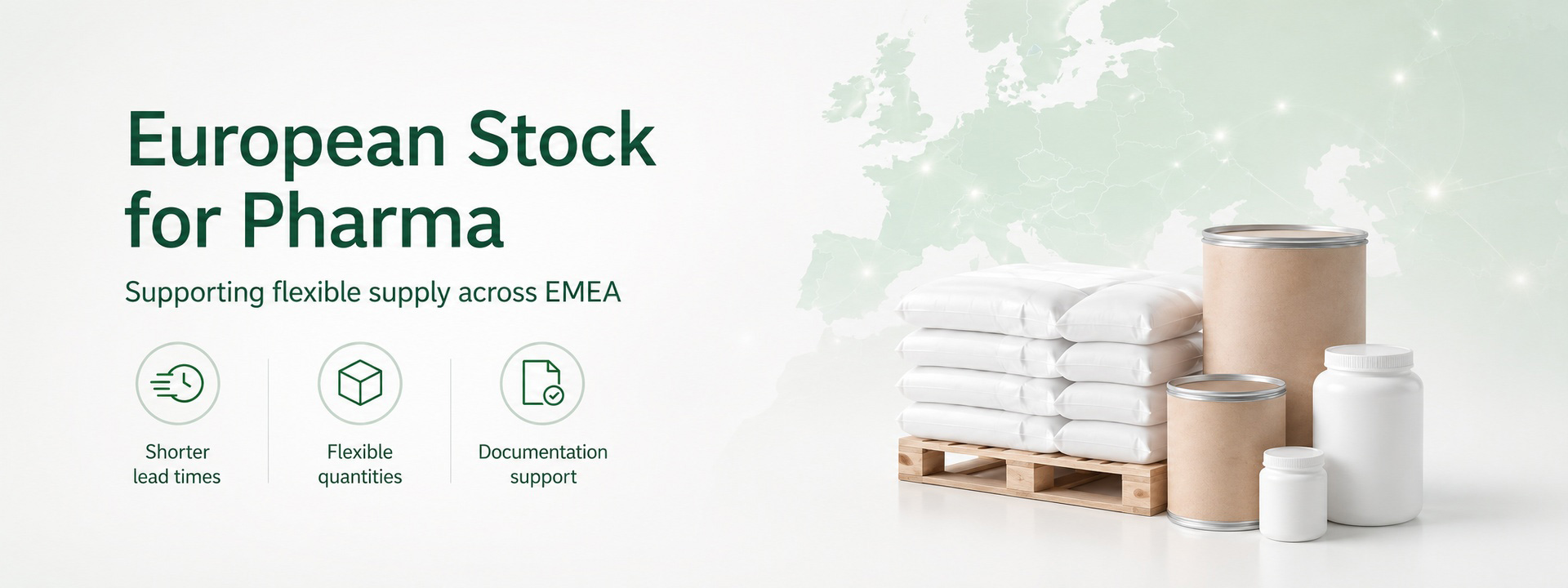
A direct manufacturer quotation may show the lowest price per kilogram, making the purchasing decision appear simple. But pharmaceutical raw material sourcing is rarely decided by material price alone. Lead time, minimum order quantity, inventory commitment, remaining shelf life, documentation, shipment coordination, and the cost of an interrupted production plan can all change the real value of an offer.
This is where European stock becomes commercially important. It is not only a faster delivery option; it can provide a more flexible bridge between global manufacturing and the customer’s actual production requirement. The real question is therefore not only where the material is manufactured, but whether the complete supply route fits the customer’s quantity, timing, qualification, and operational needs.
Why European Availability Has Become More Relevant
Pharmaceutical manufacturers are operating in an environment where supply continuity receives greater attention. On 12 May 2026, the European Commission welcomed the provisional political agreement on the Critical Medicines Act. The Act applies to critical medicines and relevant public procurement rather than every API or excipient purchase. However, the agreement reflects a wider policy emphasis on supply-chain resilience, diversification, and reduced dependency alongside price.
This does not mean that every active pharmaceutical ingredient or excipient should be manufactured in Europe. Global manufacturing remains essential. However, positioning qualified material closer to the customer can create an additional layer of operational security, particularly when the customer needs a sample, validation quantity, smaller commercial order, or urgent replenishment.
The Factory Price Is Only the Starting Point
Price per kilogram is easy to compare, while total procurement cost is more complex. A direct offer may be based on a larger quantity and may not include the full effect of international freight, export handling, banking, customs coordination, local delivery, and inventory holding. European stock may carry a higher unit price because the distributor has already financed, imported, stored, controlled, and positioned the material for future customer requirements.
The buyer is therefore comparing two different service models, not only two prices. For large and predictable annual demand, a factory-direct route can remain commercially attractive. For a smaller or time-sensitive requirement, the additional cost of regional stock may be lower than the cost of purchasing excess inventory or waiting for a new production and shipment cycle.
When Lead Time Becomes a Business Risk
A direct shipment may pass through several stages before the material reaches the customer:
- Production scheduling and batch allocation
- Quality-control testing, batch release, and document preparation
- Export handling, freight booking, international transport, and customs clearance
- Final domestic delivery to the customer’s manufacturing or warehouse site
Each stage may be managed correctly, but each one adds time and dependency. If the customer has several months of visibility, the route can be planned efficiently. The challenge appears when demand changes, a shipment is delayed, or production requires material sooner than expected.
European stock can shorten the immediate replenishment route when the correct manufacturer, grade, batch, and quantity are available. The commercial value is not simply faster transport; it is the ability to respond before a raw material shortage becomes a production problem. When continuity is at risk, a few days or weeks saved can matter more than a small difference in price per kilogram.
The Right Quantity at the Right Time
Manufacturers often work with production campaigns, pallet quantities, or larger minimum order quantities. That structure supports manufacturing efficiency but may not match every customer requirement. A pharmaceutical company may need a small quantity of HPC or HPMC for formulation work, a pilot quantity of PVP K30 or MCC, or a partial commercial volume before the next planned order.
Buying significantly more material than required increases working-capital pressure and stock exposure. For example, if a project needs 1,000 kg but the factory MOQ is 5,000 kg, capital is tied up in 4,000 kg that is not immediately required. The customer must also absorb the associated warehouse space, controlled-storage cost where applicable, stock rotation, and retest-date or expiry risk.
European stock can allow the supplied quantity to follow the customer’s actual demand more closely. This is particularly relevant for newly launched products, low-volume markets, pilot projects, registration work, and customers that prefer gradual replenishment rather than one large inventory commitment. The value is not only a lower MOQ; it is better alignment between purchasing and consumption.
From Evaluation Quantity to Commercial Supply
Many pharmaceutical projects begin long before the first commercial order. Customers may require material for laboratory evaluation, comparative testing, formulation development, stability batches, process validation, or registration activities. These quantities can be too small for a normal factory shipment and may be required faster than a new production and export cycle can support.
European stock can make the early evaluation stage more practical by providing smaller quantities from an identified manufacturer and grade. The critical point is continuity: the sample should connect to a realistic future supply route. The customer should understand whether the same manufacturer, manufacturing site, grade, specification, and documentation can support later pilot and commercial demand.
This is particularly important for functionality- and grade-sensitive excipients. ALKAN’s guides on HPMCAS in modern oral formulation, PVP grade selection, and HPC vs HPMC vs L-HPC show why grade, functionality, manufacturer, and documentation should remain aligned from initial evaluation to commercial supply.
Documentation Is Part of Availability
Physical stock is not enough if the customer cannot evaluate or approve the material. For APIs and pharmaceutical excipients, availability also depends on access to the correct specification, certificate of analysis, manufacturer details, quality statements, and application-specific documentation.
Depending on the material and application, the documentation package may include:
- GMP- or GDP-related information and manufacturer or site details
- TSE/BSE, residual-solvent, elemental-impurity, and nitrosamine-risk statements
- Stability or retest information, change-control commitments, and batch-specific records
- CEP, ASMF, DMF, or other product-specific regulatory documentation for APIs where applicable
On 9 April 2026, IPEC Europe announced Version 3 (2026) of the Qualification of Excipients for Use in Pharmaceuticals Guide and Checklist. The update states that excipient supplier qualification is fundamental to securing the excipient supply chain and emphasizes effective relationships between excipient suppliers and users.
For European stock, this means that the excipient must remain traceable through the original manufacturer, distributor, warehouse, transport route, and supplied batch. A capable distributor adds value by coordinating this information and following open questions. The distributor does not replace the manufacturer’s quality department; it provides a controlled communication and documentation interface.
European Stock Is More Than a Warehouse Address
The words “European stock” should describe more than a product physically placed in a warehouse. The real value comes from a controlled supply model that includes clear batch traceability, suitable storage conditions, stock visibility, document control, transport coordination, complaint handling, and communication with the original manufacturer.
European stock does not automatically mean European manufacturing or European customs origin. A product can be manufactured by a qualified global producer and stored within Europe for regional or international supply. It also does not mean that every product or quantity is immediately available; the exact grade, batch, documentation, remaining shelf life, and delivery date must still be confirmed.
These controls are consistent with the supply-chain principles described in the IPEC Good Distribution Practices Guide for Pharmaceutical Excipients, which applies distribution principles across manufacturers, distributors, warehouses, transport providers, traders, and other parties involved in the excipient supply chain.
The Strongest Model Is Often Flexible
European stock does not need to replace the customer’s planned bulk sourcing route. Its strongest role is to add flexibility when the standard factory model is too large, too slow, or too rigid for the immediate requirement. It can support samples, validation quantities, smaller recurring orders, buffer requirements, and urgent replenishment while larger forecasted volumes continue to be planned separately.
This creates a practical balance between planned procurement and the reality that demand, production schedules, and shipment timing do not always follow the forecast. The strongest supply strategy is not based on one route for every situation; it uses European availability where it creates the greatest operational value.
How ALKAN Chemical Europe Supports Pharmaceutical Raw Material Sourcing
For ALKAN Chemical Europe, European stock is part of a broader technical-commercial sourcing model across active pharmaceutical ingredients, pharmaceutical excipients, and specialty chemicals. Our role begins with understanding the exact product, grade, application, required quantity, expected annual demand, documentation needs, destination, and target delivery date.
Depending on the project, we can review availability from European stock, supply from the manufacturing origin, or a structured combination of both routes. This supports customers that need faster access, flexible quantities, samples, documentation coordination, alternative sourcing, or a clear path toward future commercial demand.
The objective is not only to send a price. It is to identify a realistic supply route that fits the customer’s procurement, quality, regulatory, and production requirements.
Request a Customized Sourcing Review
Send us your product specification, grade, required quantity, annual demand, destination, documentation requirements, and target delivery date.
ALKAN Chemical Europe can review European availability and flexible sourcing options across APIs, pharmaceutical excipients, and specialty chemicals.
Final Thoughts
European stock is not valuable only because it is geographically closer. Its value comes from the flexibility it can provide across lead time, order quantity, inventory exposure, documentation coordination, and urgent replenishment.
Direct manufacturer supply remains important for planned bulk demand, but the lowest factory price does not always create the best outcome for a smaller, faster, or less predictable requirement. The strongest sourcing decision considers the complete supply route, not only the product price.
For pharmaceutical buyers, the goal is to secure the right approved material, in the right quantity, with the right documentation, at the time production actually needs it.
FAQ: European Stock for Pharmaceutical Raw Materials
What does European stock mean for pharmaceutical raw materials?
It means that the material is physically stored in a European warehouse and may be supplied from that location. It does not automatically mean that the product was manufactured in Europe.
Why can European stock cost more than direct manufacturer supply?
The price may include importation, financing, warehousing, quality oversight , inventory risk, regional logistics, and commercial support. Buyers should compare the complete purchasing requirement rather than only the unit price.
When is European stock most useful?
It can be especially useful for samples, validation quantities, smaller commercial orders, urgent replenishment, newly launched products, low-volume markets, and customers seeking lower initial inventory commitment.
Does purchasing from European stock remove the need for qualification?
No. The original manufacturer, manufacturing site, product, grade, specification, and supply route may still require evaluation under the customer’s quality system.
Can European stock support long-term commercial supply?
Yes, when stock planning is connected to forecasted demand and reliable replenishment from the original manufacturer. It can also complement planned bulk shipments.
How can ALKAN support the sourcing decision?
ALKAN can review the required grade, quantity, annual demand, documentation, destination, and delivery target to identify suitable European-stock, direct-origin, or combined supply options.
Need a More Flexible Route for Your Next API or Excipient Requirement?
Request a customized sourcing review from ALKAN Chemical Europe. Send us your current or upcoming requirement and our
team will assess European availability, direct-origin supply, documentation needs, and logistics options. No commitment is required at this stage.
Disclaimer: This article is provided for general informational purposes. Product availability, quantity, documentation, lead time, and suitability must be confirmed for each individual inquiry. It does not replace the customer’s supplier qualification, quality assessment, regulatory review, or change-control procedures.
AUTHOR
Dr. Peter Michael, Procurement & Sales Manager, ALKAN Chemical Europe
Pharmacist (B.Pharm). Supporting customers across EMEA with excipient and API sourcing backed by technical documentation.